
Families of martyred asked the government to take stern action against Pakistan
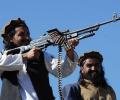
Amid accusations by Pakistan that America deliberately sabotaged peace talks by killing Taliban chief Hakimullah Mehsud, the Unites States on Sunday said the militant group has a "symbiotic relationship" with the Al Qaeda and provided "safe haven" to terrorists.
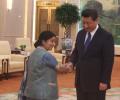
'This is a US-India effort and it is not necessarily to counterweight anyone.'

'While the meeting on December 6th was perfectly legal, was it ethical?' asks Colonel Anil A Athale (retd).

'The entire Ufa fiasco was predictable and predicted. The Ufa venue had created international interest in the initiative and its failure may have implications for both Pakistan and India. What remains for Modi to do is to produce a prettier rabbit out of his hat next time to deal with the Pakistan imbroglio,' says Ambassador T P Sreenivasan.

Pakistan has made it clear that there can be no talks with India unless Kashmir is on the agenda.
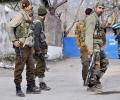
'It would be very easy for me to say, it's only the Pakistanis that want the Kashmir issue to remain alive.' 'Trust me, there is a vested interest on the Indian side in keeping the issue of Jammu and Kashmir alive.'

'There were assurances that Jaish-e-Mohammad was being reined in as was the Lashkar-e-Tayiba, but Pakistan's security forces could not risk opening too many dangerous new fronts,' notes former foreign secretary Ambassador Shyam Saran, who has just returned from a visit to Lahore.

'We are encouraged by what the prime minister said recently on these issues... We will keep a close eye on these issues. They are very important and as are other elements of our human rights and religious freedom.' 'So, absolutely, we'll keep a focus on them.'

'If you invest your entire capital in talks, you cannot abruptly change gear and decide on war.'

'If the US-Pakistan relationship continues to suffer, Pakistan may feel it has less to lose and decide that it need not keep a leash on LeT in order to appease America.' 'A tougher US policy toward Pakistan could lead to an emboldened and strengthened LeT and JeM, resulting in more terrorist attacks in India.'

India has strongly hit back at Pakistan, saying the "sell-by date" of the country's "anachronistic approach" is long over and there is absolutely no support in the world body for claims on Kashmir by a nation that established itself as a "global epicenter" of terrorism.

New Delhi and Beijing are the only two regional capitals that have commented on US President Donald Trump's speech on August 21 outlining the way forward in Afghanistan. The Indian foreign ministry statement was effusive in praise, while the Chinese statement has been one of cautious and guarded hope. Delhi has identified itself with Trump's Afghan strategy, whereas the Chinese stance is calibrated -- observant and objective, keeping a distance, says Ambassador M K Bhadrakumar.
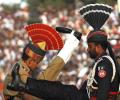
'Despite Modi's high-flown rhetoric about good-neighbourly relationships in South Asia, he lacks a road map how to proceed -- be it with Bangladesh or with Sri Lanka and Pakistan... But a deeper question arises here: Did he duck on his own accord or under the diktat from the RSS, asks Ambassador M K Bhadrakumar.
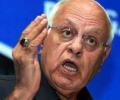
National Conference leader and former Jammu and Kashmir chief minister Farooq Abdullah has rejected the notion that the threat of a nuclear war would solve the Kashmir issue, asserting that the region would never be a part of Pakistan and dialogue is the best way to "move forward".
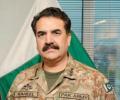
Ending weeks of speculation, Prime Minister Nawaz Sharif on Wednesday appointed Lt Gen Raheel Sharif as Pakistan's new army chief and Lt Gen Rashid Mehmood as the chairman joint chiefs of staff committee.

'The Modi government knows that much cannot be expected of Pakistan till the Kulbhushan Jadhav issue is resolved,' says Rajeev Sharma.
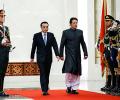
'Imran cannot escape responsibility for providing a mask to the Pakistan army to engage in unlawful activities and to wage aggression after India retaliated to the terrorist attack,' says Ambassador T P Sreenivasan.

'Trade cannot take place when there is no trust.'
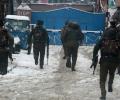
'We need to be in a perpetual state of aggression, and able to swiftly change the goal posts to keep Pakistan in a state of imbalance,' argues Sanjeev Nayyar.

The declaration also names Pak-based terror groups like LeT and JeM.

'The National Conference and the Peoples Democratic Party, as recent events suggest, are quite content as New Delhi's collaborators rather than trying to be true representatives of the Kashmiri people,' says Athar Parvaiz.

'We are completely engaged in fighting poverty; alas, our neighbour Pakistan seems only engaged in fighting us.'
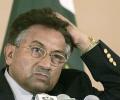
Pakistan's ruler Pervez Musharraf and his top diplomats made a U-turn on talks with India after the then Prime Minister Atal Bihari Vajpayee released Hurriyat leaders in early 2000 as part of his peace initiatives on Kashmir, according to a declassified US cable.

Rediff.com reproduces this 2014 interview with Tim Kaine where in he discusses the new opportunities to foster Indo-US trade and the improvement in ties.

'Diplomatic engagement will continue even as India keeps all its options open with respect to discretely targeting the Pakistani military and its terrorist proxies.'

'Pakistan persists in the belief that such attacks will enable it to obtain the territory it covets. Their plans will not succeed.'

Cancelling Uighur leader Dolkun Isa's visa could have been a mutual face-saving exercise for New Delhi and Beijing.
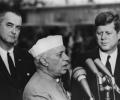
As Prime Minister Narendra Modi begins his historic visit of the United States of America, here's a look at some landmark visits by Indian prime ministers to the United States of America.
'India should be more confident and let Pakistanis meet Hurriyat leaders. India's main concern is terrorism, and India should talk terrorism. If that means talking Kashmir, so be it. India can't answer terror with terror because we don't have terror factories. India can't answer terrorism with war because we both have nuclear weapons. That leaves talks as the only option,' says Shivam Vij.

Sushma Swaraj's suave moves helped Narendra Modi pull off a diplomatic coup, helping regain her standing.
'We cannot forget that Pakistan is a criminal State, it is a rogue State and yet we want oil pipelines to go through their State, we want to have people-to-people contact, want to increase trade with them.' 'When Modi was prime minister-elect, he said there can be no dialogue in the face of bombs and bullets. After becoming prime minister, he is saying talks will continue. Was he then misleading the public then or is he misleading the public now?' 'Nobody goes around abusing China. The fact is China is a great power. I do not think India is a great power. People spit on our face and we still go grovelling before them.'
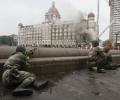
Through its early days to the 1980s, Pakistan sought to expand its sphere of Islamic influence through Afghanistan to Central Asia and got Pakistani citizens recruited in the Afghan government institutions in the 1990s when the Taliban were power. Now, it is looking eastward through India to Bangladesh and Myanmar to establish an imaginary caliphate.

'The Senators were playing safe, not angering either the pro-India lobby or the pro-Pakistan lobby, but perhaps more importantly, the military-industrial complex -- the most powerful lobby of all -- which the majority of Senators are beholden to in terms of largesse to their campaign coffers.'

Bilawal Bhutto's political inheritance is his biggest asset as well as the biggest liability as he tries to make his mark in Pakistan politics. Challenging the Taliban militants is part of that strategy, though it matches with his political ideology. Shahzad Raza profiles the son of Benazir Bhutto and Asif Ali Zardari.

'One lesson to emerge out of the Modi-Putin summit is that India can be more self-confident that it possesses inherent strengths to leverage its interlocutors to influence Pakistani policies,' says Ambassador M K Bhadrakumar.

'In Chinese perception, India is strategically getting closer to United States and some Chinese analysts fear perhaps one day it may become a part of American arrangements against China.'
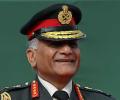
Alleging that V K Singh had not only damaged the reputation of the army but also of India, Union Minister Farooq Abdullah on Saturday said the former army chief should be stripped of the title of Colonel of Rajput Regiment for "lying".

'India has to judge what Pakistan says to us, not what they say to a domestic audience,' a source tells Sheela Bhatt/Rediff.com, explaining why India-Pakistan talks remain on track despite discordant noises from across the border.

'When it comes to India-Pakistan relations, seminal moments of progress invariably bring out saboteurs of peace -- whether we're talking about fresh provocations along the LoC, or even a terror attack in India.'
 © 2026 Rediff.com - Advertise with us - Disclaimer - Privacy Policy - Sitemap - Feedback - About us - Terms of use - Grievances